Showing posts with label potato. Show all posts

Thursday, October 18, 2012

Week 18: Potato and Onion Knishes


After a potato-filled summer that led to a potato-filled fall, this is a fitting (and filling!) way to send off the CSA season.

How many potatoes? you ask. We totaled 42 pounds over the last 15 weeks. Clearly we hit some kind of weather jackpot for potatoes. (The other notable delivery: six heads of cabbage and six heads of cauliflower, which doesn't sound like a lot -- until you start thinking about eating a head of cabbage and a head of cauliflower each week for a month or so.)

Back to the potatoes: You'll need only a pound and a half, or about 3 medium potatoes, to make these knishes. Which you should do. Like, now. They are fantastic, and they are much easier to make than you might think.

For the recipe, I must refer you to the Smitten Kitchen website. I used the dough recipe as written and made one small change to the potato and caramelized onion filling, substituting olive oil for the butter to keep the knishes dairy free. The Joe Pastry blog, which provided the recipe that inspired the Smitten Kitchen version, also has fantastic step-by-step photos for rolling out and shaping the knishes.

And with that, the season is over, though the kitchen never really closes. Love and knishes to you all.

Thursday, September 6, 2012

Week 12: Aloo Gobi (Potatoes and Cauliflower)


I'll be upfront: I have no idea how closely this recipe resembles the traditional Punjabi dish of spiced potatoes and cauliflower. It might just share the name. Doesn't matter, really. This is a great late-summer harvest dish, especially on a day that has just enough of a chill in the air to suggest a change in season.

Aloo Gobi (Potatoes and Cauliflower)
(Adapted from a Food.com recipe)

2 Tbsp canola oil (or another neutral-tasting vegetable oil)
1 large onion, peeled and diced
1 tsp cumin seed
1 bunch cilantro, leaves and stalks separated and roughly chopped
1 T minced ginger
2 cloves garlic, minced
1 tsp turmeric
1 tsp salt
1 tsp chili powder
3 cups diced fresh tomatoes (2 to 3 tomatoes)
1 small cauliflower, separated into florets
3 potatoes, peeled and cubed (to be about the same size as the florets)
2 tsp garam masala (make-your-own recipe at the bottom of this post)

Heat the oil in a large saucepan, then add the onion and cumin seeds. Cook together until the onion becomes translucent, about 5 minutes. Add the cilantro stalks, ginger, garlic, turmeric, salt, and chili powder to the onions, and cook another minute or two. Stir in the tomatoes, and cook about 5 minutes, or until the tomatoes begin to break down. Add the potatoes and cauliflower, turning them in the sauce to coat. Cover and simmer the mixture for about 20 minutes, stirring occasionally, or until the vegetables are cooked through. Stir in the garam masala and cilantro leaves near the end of the cooking time.

Thursday, August 16, 2012

Week 9: Pizza With Potato, Rosemary, and Caramelized Onions


It's shaping up to be a potato-filled summer. How so? We're at the half-way point of our CSA season, and we're up to 16.5 pounds of potatoes. Last year, it was only 4 pounds for the entire 18 weeks. In 2010 and 2009? No potatoes at all. (Wait, I'm not the only one who keeps spreadsheets of such things, am I?)

I like the carb-on-carb combination of this pizza, even though it didn't use up a lot of potatoes. The topping would work on focaccia as well. (For another take on potatoes and dough, consider pierogies, which, admittedly, don't taste anything like this pizza.)

Pizza With Potato, Rosemary, and Caramelized Onions
(Adapted recipe, inspired by many Internet sources)

1/2 pound new potatoes (2 to 3 small potatoes), scrubbed but not peeled
1 onion, sliced
Olive oil
Prepared pizza dough for a 12- to 14-inch pizza
1/4 cup shredded Parmesan cheese
3 to 4 cloves garlic, minced
Salt and pepper to taste
1 Tbsp chopped fresh rosemary

Prepare the vegetables: Boil the potatoes gently in enough salted water to cover, about 15 minutes or until just tender. Drain and rinse with cold water. When cool enough to handle, slice the potatoes about 1/4-inch thick.

Meanwhile, heat 1 tablespoon olive oil in a wide skillet. When the oil is shimmering, add the onions. Cook over low heat until they are very soft, browned, and sweet, stirring occasionally, about 30 minutes.

Construct the pizza: Heat your oven to 450 degrees. Stretch the pizza dough into your pizza pan. (Note: a 10-by-15-inch baking sheet has about the same surface area as a 14-inch round.) Brush the dough with olive oil. Spread the Parmesan cheese evenly on top, then layer the  potato slices, caramelized onion, minced garlic, salt, pepper, and rosemary. Drizzle a little olive oil on top (1 to 2 tablespoons). Bake 15 minutes, or until the crust is cooked through and golden.

Thursday, July 19, 2012

Week 5: Dressed Carrots and White Beans; No-Fuss Potato Salad


There's a certain irony in writing a food blog in the summer. The produce is great, but do you really want to turn on the oven when it's roasting outside? This week, in the interest of energy conservation (mine at least), I've been sticking mostly to salads and stovetop-prepared foods that let me get in and out of the kitchen (and blog) quickly. Here are two to try when you need something quick, easy, and good for a cookout or barbecue.


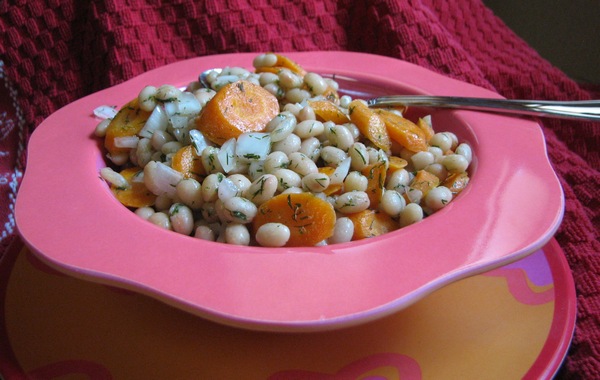
 Dressed Carrots and White Beans
(Adapted from 101 Cookbooks. Serves 3 to 4 as a side dish.)

1 Tbsp regular olive oil, plus a little extra for sauteing
1.5 cups slender carrots, sliced thinly on the diagonal (about 3 to 4 carrots)
1 15-ounce can small white beans, rinsed and well-drained
2 Tbsp finely chopped dill leaves
1 Tbsp light brown sugar
1 Tbsp fresh lemon juice
Dash salt
About 1/4 cup thinly sliced white onion (mild or sweet variety)

Heat a bit of olive oil in a large skillet over medium-high heat. Add the carrots and cook about 6 minutes, tossing occasionally, or until they begin to soften and brown. Add the beans and dill and cook about 3 minutes longer, or until the beans are heated through. Transfer the mixture to a serving bowl, sprinkle with the brown sugar, and stir gently; the sugar will dissolve. Whisk together the tablespoon of olive oil, lemon juice, and salt. Pour over the carrot-bean mixture. Stir in the onions. Serve warm or at room temperature.

No-Fuss Potato Salad
(A personal recipe, but inspired by several sources. Serves 4 to 6.)

2 lbs new potatoes, scrubbed clean but not peeled
3/4 cup mayonnaise
1 Tbsp apple cider vinegar
1/2 Tbsp white granulated sugar
1/2 Tbsp prepared yellow mustard
1/4 tsp table salt, or to taste
1/2 tsp garlic powder
1/4 tsp ground black pepper, or to taste
1 celery stalk, diced
1/2 cup diced white onion
2 scallions, sliced
Paprika

Boil the potatoes in a saucepan of salted water, 20 to 25 minutes or until fork tender. Drain and cool the potatoes, remove peels if desired, then cut the potatoes into cubes. Place the potatoes into a large bowl.

Mix together the mayonnaise, vinegar, sugar, mustard, salt, garlic powder, and black pepper. Pour over the potatoes. Add the diced celery and onions and stir gently to combine. Chill in the refrigerator. Before serving, garnish the potato salad with the sliced scallions and paprika.

Thursday, July 5, 2012

Week 3, Part 1: Spiced Potatoes and Cilantro-Mint Dressing


My daughters are 12 and 14 this summer, and you would think that after 12 years or 14 years of feeding my kids that I would know what they would like to eat. You would think that, but, like me, you would be wrong. Two non-adventurous eaters going for spiced potatoes (and in particular, Indian-food-style spiced potatoes)? Who would have guessed? I'm documenting this surprising event in my blog so I can remember it the next time they are being fickle and contrary over whatever I'm serving. Which will probably be at dinnertime tonight.

The potatoes have an addictive quality to them, and a bit of kick from cayenne pepper. The cilantro-mint dressing somewhat tames them, but has a kick of its own, from jalapeno pepper. I'm finding that all herby, green dressings are somewhat similar -- this one isn't far from chimichurri or cilantro-basil sauce -- but I accomplished my primary goal of the week, which was to use up a bunch of cilantro and work down some mint. If you don't have the herbs on hand, the potatoes are fine without the dressing.

Spiced Potatoes and Cilantro-Mint Dressing
(Adapted from Deborah Geering's recipes for Atlanta Magazine. In addition to vegetables, the cilantro-mint dressing would complement grilled meat or fish.)

For the dressing:
1 jalapeno pepper, stemmed, seeded and roughly chopped
1 bunch cilantro, leaves only (about 2 cups)
2 to 3 sprigs mint, leaves only
1/2 tsp salt
2 Tbsp canola oil, or another flavorless vegetable oil
2 Tbsp water
Juice from 1/2 lime (about 2 Tbsp)

Place the jalapeno, cilantro, mint, and salt in the bowl of a food processor and pulse until coarsely chopped. Add the oil, water, and lime juice and process until smooth, scraping sides if necessary. Makes about 1/2 cup.

For the potatoes:
3 baking potatoes (such as russets), cut into 1-inch cubes
2 to 3 Tbsp canola oil
2 tsp cumin seed
1.5 tsp garam masala (see note below)
1.5 tsp ground tumeric
1/2 tsp ground cayenne pepper
1 tsp kosher salt

Place the potatoes in a large pot (I used my 5-quart Dutch oven) and cover with water. Bring to a boil, and cook the potatoes until they can be pierced with a fork, about 5 minutes. Drain. (Parboiling the potatoes cuts down on the subsequent roasting time. You can skip this step, and roast the potatoes for longer.)

Preheat your oven to 400 degrees. Pour the oil onto a large rimmed baking sheet (e.g. 10-by-17 inches). Add the potatoes and toss to coat with oil. Mix the spices together and sprinkle them over the potatoes; toss again to coat. Arrange the potatoes so they are in a single layer, and roast until browned and cooked through, about 30 minutes if you parboiled them.

Note: Garam masala is a spice mix available at many grocery stores. One way to make your own is to mix: 

1/4 tsp (or 1 part) ground clove
1/4 tsp (1 part) ground cinnamon
1/4 tsp (1 part) ground nutmeg
1/2 tsp (2 parts) ground cardamon
1/2 tsp (2 parts) ground black pepper
1 tsp (4 parts) ground cumin
1-1/4 tsp (5 parts) ground coriander

Friday, March 2, 2012

Eggs Baked in Hash Brown Cups

We eat a lot of "breakfast for dinner" around here, especially on nights when not everyone is home, so I'm always on the lookout for good main-dish egg recipes. Kit and I had dinner-for-two recently, and these baked eggs were definitely a step up from our more-mundane scrambled eggs and toast. They did have this slightly disconcerting quality, in that they seemed to stare up at us from the plate ...

 
but that problem was easily resolved with a knife.


Besides making for a light supper, these baked eggs would be ideal for a cozy Sunday brunch, and they would not be out of place on an Easter or Passover table. Or on a Halloween table, for that matter (it's the eyeball thing).

If you are not crazy about the fried-egg look, you could fill the hash brown cups with beaten eggs to make a scrambled or quiche-like center, though I did not test the recipe that way.

Eggs Baked in Hash Brown Cups
(Adapted from Everyday Food and various Internet recipes. Suitable for Passover and gluten-free cooking, but always check your food labels. Serves 2 to 3; should double easily.)

2 tsp olive oil, plus extra for greasing and sauteing
About 2.5 cups frozen, unseasoned hash browns, thawed
Salt and pepper to taste
1/2 cup diced red bell pepper
1/4 cup sliced green onion
3 Tbsp grated cheddar cheese
3 large eggs

Preheat your oven to 475 degrees. Lightly grease 3 ramekins (about 6-ounce capacity) or jumbo muffin cups.

Mix the thawed hash browns with the 2 teaspoons of olive oil, salt, and pepper. Divide the mixture evenly among the prepared ramekins. Press the hash browns firmly and evenly against the bottom and sides of each cup. Bake 15 minutes or until slightly golden.

Meanwhile, saute the red bell pepper (using a little olive oil or cooking spray, if necessary) until slightly softened, about 4 to 5 minutes. Stir in the green onion and cook 1 minute more. Remove vegetables from heat.

Divide the vegetable mixture among the cooked hash brown cups and top each cup with about 1 tablespoon of cheese. Bake 2 minutes. Remove from oven.

Carefully crack an egg into each cup. Bake 8 to 12 minutes, until the whites are set and the yolks are done to your liking. Remove hash brown cups from ramekins and serve at once.

Friday, November 4, 2011

Vegetarian Shepherd's Pie


Photography is not my strong suit. Which means that I have to invite you all over for dinner, since the food looks much better in person.

I might serve you this. (It would help if you liked eggplant.) This was one of the most satisfying meals that The Programmer and I had last month -- several meals, actually, since Kit prefers eggplant in the form of eggplant Parmesan and Caboodle prefers that eggplant just stay at the farm and be fed to livestock.

What took the dish over the top for us is that I substituted slow-roasted fresh tomatoes for canned ones. That's less likely an option for you now (snow season! gak!) but keep this in mind for when you are inundated with tomatoes next summer or early fall: Cut a bunch of tomatoes in half or in wedges, place them on a parchment-lined baking sheet, drizzle them with a little olive oil, and bake at a low temperature -- 225 to 250 degrees F -- for about two hours. The tomatoes will begin to dry out, which concentrates their flavor. You can also roast the tomatoes at a higher temperature (say 325 degrees) for a shorter time; they will brown and caramelize along the edges.

Vegetarian Shepherd's Pie
(Adapted from Vegetarian Times. I especially liked the original recipe's idea to place some of the vegetables on top of the mashed potatoes. This version removes the eggs, cuts down on the fat, and makes minor ingredient substitutions. Serves 6 to 8.)  

2 lbs red-skinned potatoes, peeled only if desired and cut into cubes (about 6 cups)
1/4 cup non-fat milk
1 Tbsp unsalted butter
Salt and pepper to taste
2 Tbsp olive oil, divided use
1 medium onion, coarsely chopped (1 cup)
2 cans (about 15 oz. each) diced tomatoes with liquid, or 1 can diced tomatoes and 2 cups of roasted fresh tomatoes
2 eggplant (about 1.5 pounds total), peeled only if desired, and cubed
About 2 Tbsp fresh herbs, chopped, to taste (I used about 1 Tbsp basil and a combination of parsley, oregano and thyme)
2 cloves garlic, minced
1/2 cup grated Parmesan cheese
1/2 cup panko breadcrumbs
1 green bell pepper, sliced thin
1 small zucchini, sliced thin

Place the cubed potatoes in a large pot, cover with water, and bring to a boil. Cook the potatoes 10 to 15 minutes, or until soft. Drain, and mash with milk and butter. Season with salt and pepper, and set aside.

Meanwhile, heat 1 Tbsp olive oil in a Dutch oven over medium heat. Saute the onion in the oil for about 5 minutes, or until it begins to soften. Add the tomatoes, eggplant, herbs, and garlic. Bring to a boil, then lower the heat and simmer 20 minutes or until the vegetables are soft. Remove from heat, and stir in the Parmesan cheese and breadcrumbs. Taste the mixture and add salt and pepper as desired.

Spread the potato mixture over the vegetables in the Dutch oven, banking it up a little along the sides and leaving an indentation in the middle.

Heat the remaining 1 Tbsp of olive oil in a large skillet over medium heat. Add the bell pepper and zucchini, and sauté for 7 to 10 minutes, or until just tender. Pile the sautéed zucchini and bell pepper into the center of the mashed potatoes.

Bake the casserole at 350 degrees for 20 minutes or until heated through.

Wednesday, October 12, 2011

Week 18: Green Tomato Curry

Eighteen weeks is a long time – just over a third of a year.  We’ve gone from peas to pumpkins, from strawberries to winter squash.

I think I’m going to miss the tomatoes most of all.

I rhapsodized about ripe tomatoes earlier this season. This time of year, it’s about the green ones. Fully grown, unripe tomatoes are firmer and more acidic than their red counterparts, although they mellow with cooking. They are commonly breaded and fried, but you can also slow-roast them, pickle them, or turn them into relish or chutney. They work in all sorts of stews and show up in Indian dishes. The recipe below makes a mild curry that takes on a deep yellow color from turmeric.

Before we get to the recipe, a little reminder: Now that the CSA season has ended, I'll be posting less frequently. But I'm always cooking, so expect some seasonal recipes for the fall and winter. (Subscribe to the blog and you won't miss any posts.)

Green Tomato Curry
(Adapted from Cooking Light. Serve with basmati rice, quinoa, or a flat bread like naan. Serves 2-3 as a main dish or 4 as a side.)

1 Tbsp ground coriander
2 tsp ground cumin
1 tsp salt
1 tsp turmeric
1/4 tsp ground cayenne pepper
1 Tbsp canola oil
2 tsp yellow mustard seeds
2 cups green tomato, diced (about 1 large tomato)
2 cups diced, peeled russet potato
2 cups cauliflower, in small florets
1.5 cups water

Mix the ground spices together in a small bowl and set aside. In a large skillet, heat the oil over medium-high heat. Add the mustard seeds and cook for 1 minute; the seeds may sputter and pop, so have a lid or splatter guard handy. Add the tomato, potato, cauliflower, and spices, and stir until blended. Add the water and bring the mixture to a boil. Reduce the heat, cover the skillet, and simmer the mixture for 20 minutes, or until the vegetables are tender, stirring occasionally. Uncover the skillet and cook about 5 minutes more or until most of the liquid evaporates. Serve hot.

Wednesday, September 14, 2011

Week 14: Creamy Corn Chowder, Without the Cream

The Programmer and I have spent much of the past couple of weeks reconfiguring office spaces. The process has been akin to an archaeological expedition: We’re unearthing files and mementos that haven’t seen the light of day in several years. Just this week I came across cute letters from the kids, preschool-era photos, printouts of work emails from employers that no longer exist, a techie parody of The Hollow Men, and a raft of editing-related cartoons clipped from various newspapers.

What does this have to do with working through our CSA stash? Not much directly, but after spending hours sorting, tossing, and moving all of this stuff, I’ve had to contend with (a) limited time in the kitchen and (b) a strong desire for comfort food. Both of these conditions led me to pull together this week’s recipe, a quick and satisfying soup that makes good use of late-summer corn.

Creamy Corn Chowder, Without the Cream
(Inspired by a USA Weekend recipe)

6 ears corn, husked
1 Tbsp olive oil
1 onion, peeled and diced
1/2 cup diced red bell pepper
1 pound new potatoes, diced
3 cups water
1 Tbsp fresh thyme leaves
1 tsp salt, or to taste
Coarsely ground black pepper, to taste
1 Tbsp chopped fresh parsley leaves

Cut the kernels from 3 ears of corn, and scrape the cobs with the back of your knife to release any liquid. Puree the kernels and liquid in a food processor and set aside. You should have about 2 cups of corn puree.

Remove the kernels from the remaining 3 ears of corn and set aside.

Heat the olive oil in a large soup pot or 5-quart Dutch oven over medium-high heat. Add the onion, bell pepper, and cut corn kernels (but not the puree), and sauté until tender, about 5 minutes.

Add the pureed corn, diced potatoes, water, thyme, salt, and pepper. Bring to a boil, then lower the heat. Simmer, partially covered, 12 to 15 minutes, until the potatoes are cooked through and the flavors blend.

Stir in the parsley. Taste, adjust seasonings as necessary, and serve hot. Serves 4 to 6.

Thursday, April 14, 2011

Egg-Free, Dairy-Free Pierogies, With Potato and Onion Filling

The instructions may seem long,
but pierogies are fairly easy to make.
Sometimes I cook a category of food unintentionally. This past month we’ve had a lot of “pockets,” starting with hamantashen (chocolate and peach jam fillings), progressing to pot stickers (beef and vegetarian), and, most recently, pierogies.

Family ties to Poland notwithstanding, I make no claims of authenticity when it comes to pierogies. But these were fun to make -- I had not only a cooperative dough, but also a cooperative teenage helper. The pierogies got high praise from Kit, who would eat a standard box of pierogies by herself in one sitting if we would let her.

Pierogies strike me as a good pre-Marathon food: Plenty of carbs in potato-filled pasta.

Pierogies, With Potato and Onion Filling
(Adapted, slightly, from Post Punk Kitchen. Makes 24 to 30 pierogies.)

For the Filling
1.5 pounds Yukon gold potatoes, peeled, cut in 3/4-inch dice
2 Tbsp canola oil
1 onion, finely chopped
1/4 tsp ground black pepper
1/2 tsp salt

For the Dough
3 Tbsp canola oil
1 cup warm water
About 3 cups all-purpose flour, divided use, plus extra for sprinkling
3/4 tsp salt

Make the filling: Place the diced potatoes in a medium saucepan, cover with water, and bring to a boil. Lower heat to a simmer, cover the pot, and cook the potatoes for about 15 minutes or until soft. Drain the potatoes.

Meanwhile, heat the oil in a large sauté pan, and cook the onions for 5 to 10 minutes, stirring occasionally, until soft. Combine the onions, drained potatoes, salt, and pepper, and mash together. Set the filling aside to cool. (You can make the filling ahead of time and refrigerate.)

Make the dough: Have on hand a large baking sheet, lined with parchment paper and lightly floured.

Pour the oil and water into a large bowl. Add 2 cups of flour and the salt. Use a fork to stir the flour into the liquid. As it comes together, use your hands to knead the mixture, forming a loose dough. Sprinkle your work surface with flour and turn the dough out of the bowl. Knead the dough, working in the remaining cup of flour a little at a time. (Depending on conditions in your kitchen, you may need a little more or less flour.) Continue kneading the dough until it is smooth and elastic, about 10 minutes.

Divide the dough in half. Dust your work surface and a rolling pin with flour. Roll out one half of the dough to about 1/16-inch thick. Cut circles of dough, 3.5 to 4 inches in diameter. Place the circles on the prepared baking sheet and refrigerate them as you roll and cut the remaining half of the dough. Reroll and cut any dough scraps.

Complete the pierogies: Fill each round with about 1 tablespoon of the potato-onion mixture, dab water around the edges of the dough, and fold into a half-moon shape. Crimp the edges with a fork. Place filled pierogies on the floured baking sheet until you are ready to cook.

Bring a large pot of salted water to a boil. Gently lower six pierogies into the water (a large slotted spoon or skimmer is good for this) and cook them for about 4 minutes; they should float when they are done. Remove cooked pierogies to a plate and cover them with foil to stay warm as you boil the remaining batches.

You can further cook boiled pierogies by frying them, but I never got a chance to try that -- Kit got to the leftovers first.

Tuesday, March 15, 2011

Culinary Confessions and a Non-Recipe for Colcannon

As you know, this blog is focused on produce and community-supported agriculture, and it features a lot of from-scratch recipes. But I didn't always eat or cook this way. My culinary beginnings included a fair amount of Cheez Whiz and Bisquick, brownie mixes, and cans of cream-of-mushroom soup -- though, fortunately, not all in the same dish.

Every once in a while I still dip into the realm of "semi-homemade"; which is why The Programmer did not get a home-baked layer cake on his birthday, but rather a parfait that featured instant pudding mix, frozen whipped topping, strawberries, and cubes of angel food cake. The cake, which I had in the freezer, was homemade, but it may have been a relic from The Programmer's birthday celebration last year. This reminded us of the "leftover parfait" bit from Malcolm in the Middle. Ours was a leftover parfait parfait.

Pudding Parfait
Not from scratch ...
but it tasted good.

By way of redemption, I present to you a non-recipe for Colcannon, just in time for St. Patrick's Day. Colcannon is simply boiled potatoes mashed with boiled cabbage or kale -- seasonal ingredients and authentic to Ireland.

Colcannon (Kale version)

Use a waxy potato variety, such as Yukon Gold, for mashing. I cut my potatoes into quarters for boiling, and don't bother peeling them until they have cooked.

Colcannon made with kale
Boil and drain about 2 pounds of potatoes. Let them cool slightly and remove peels as needed. Mash the potatoes, adding butter and warm milk, or pareve margarine and potato-boiling liquid, depending on whether you need to keep the recipe dairy free. Keep the mashed potatoes warm.

Meanwhile, remove and discard the stems from a bunch of kale. Roughly chop the leaves and boil or steam them until tender. Let the kale cool a bit, then chop finely.

Mix the cooked kale into the mashed potatoes, adding salt and pepper to taste. And that's pretty much it, though you could easily add in onions, garlic, or other seasoning if you like. If you have more cooked kale than you need for the potatoes, save it for another use, such as quiche or soup.

Monday, February 8, 2010

Winter Ratatouille

On the subject of bowls, here's the recipe for last night's ratatouille. I think it's misnamed; it's full of what I would consider late summer/early autumn vegetables rather than dead-of-winter produce. Still, I was able to take advantage of my greengrocer's special on zucchini.

Winter Ratatouille
(Adapted from The Times of London)

Fat-free olive oil cooking spray
2 onions, finely sliced
2 garlic cloves, minced
1 (14.5 ounce) can tomatoes (petite diced)
Kosher salt and black pepper to taste
1 bay leaf
Rosemary leaves from 3 sprigs
Thyme leaves from 10 sprigs
3 parsnips, peeled and sliced (remove any woody cores)
1 sweet potato, peeled and sliced
1 large globe eggplant, cubed (or 3 slim Japanese eggplants, sliced)
2 to 3 zucchini, sliced into half-moons
1 cup water
2 Tbsp red wine vinegar

Spray the bottom of a Dutch oven with cooking spray; heat. Saute the onions until soft, about five minutes.

Add the garlic, tomatoes, salt, pepper and herbs, and cook for about 15 minutes until the tomatoes thicken slightly.

Add in the remaining ingredients and bring to a boil. Reduce heat, cover, and simmer for 30 to 40 minutes or until the vegetables are tender and coated with the sauce. If the stew is too soupy, increase the heat and cook, uncovered, to reduce the liquid. (I did not have to do this).

Serve as is or over pasta. The ratatouille can be made ahead and reheated.

Tuesday, January 26, 2010

Back to Our Roots

root vegetablesGotta love New England in January. Snow, drizzle, flurries, a peek of sunshine, a little thaw, some freezing rain. And that was just one afternoon last week.

Perfect weather for some ice cream. The girls and I have been treating ourselves to sundaes, but it's not a long-term strategy. So in between the frozen treats I've been focusing on stews and casseroles and roasts. Root vegetables have starred in several of these meals; not only are they widely available this time of year, but they also hold up well in the long-cooking, kitchen-warming dishes that I reserve for winter.

We found an array of root vegetables and other wintry things (like squash, and, um, gelato!) at the winter farmers' market in Wayland. It's worth a visit if you are in the area, but go early: We apparently missed out on some greenhouse-grown Swiss chard.

Part of the farmers' market haul wound up in this stew:

Vegan (and Fat Free) Winter Vegetable Stew
(adapted from the International Vegetarian Union web site)

Peel and cube:
1 rutabaga
3 turnips
3 to 4 carrots
1 sweet potato
2 to 3 white potatoes

Chop:
1 large onion

Rinse well:
1/2 cup barley

Put everything into a large stew pot (mine holds 8 quarts), and add water to cover (about 11 cups). Bring to a boil, then lower heat and let simmer for about an hour, until all is nearly tender.

Add:
1/3 cup red lentils
1 tsp dried sage
1 tsp dried rosemary
1 tsp dried tarragon
salt and fresh ground black pepper to taste

Simmer until the lentils have cooked, fallen apart and thickened the stew, about 20 minutes. Add more water if necessary.

Notes: The recipe yields a ton (about 16 cups), so keep that in mind if you have a vegetable-averse household. Like most stews, this one tastes even better the second day. Leftovers will continue to thicken because of the barley.

Saturday, December 26, 2009

Soup's On

Mother Wolff SoupI make soup all year round, but I love, love, love soup on a cold day. My pantry is stocked with dried peas and lentils for spur-of-the-moment pots of goodness, but sometimes I break out more time-consuming recipes. On a rather blustery day, Mother Wolff Soup simmered on my stovetop for about four hours, requiring only the occasional stir. The soup came out more brothy than I expected -- especially in light of the ingredient list: lima beans and barley and rice and potatoes. Still, Kit went for a second bowlful, and leftovers improved from sitting in the fridge for a day or two, so the recipe is a keeper.

A much quicker soup is Vegetarian Split Pea. It's stick-to-your-ribs thick and it goes from pantry to table in less than an hour.

Mother Wolff Soup
(adapted from Sundays at Moosewood Restaurant)

4 quarts water
1/2 cup dried lima beans, soaked overnight
1 cup cooked rice
1/2 cup barley
4 large garlic cloves, minced
1 Tbsp dried dill
1 bay leaf
2 Tbsp vegetable oil
1 cup diced onions
1 cup chopped celery
1 Tbsp sweet paprika
1 cup diced potatoes
1 cup diced carrots
1/2 tsp salt
ground black pepper
1 cup frozen peas
1 cup chopped canned tomatoes
1/4 cup chopped fresh parsley

In a large soup pot, combine water, drained limas, rice, barley, garlic, dill, and bay leaf. Bring to a boil, then lower heat, cover and simmer for 1.5 hours.

About an hour into the simmering time, heat the oil in a large frying pan and saute the onion and carrots for a few minutes. Mix in the paprika, potatoes, carrots, salt, and pepper. Cover and cook for a few minutes, stirring frequently, then add in the peas and cook, covered, a few minutes more.

Remove the bay leaf from the soup pot and add in the sauteed vegetables, tomatoes, and parsley. Add more salt and pepper if desired. Simmer the soup, on low heat, for another 1.5 to 2 hours, stirring occasionally.

Vegetarian Split Pea Soup
(adapted from various recipes)

1 Tbsp olive oil
1 large onion, diced
1 carrot, diced
7 cups water
1 lb dried split peas
1 Tbsp fresh thyme
Juice of one-half lemon (or more, to taste)
1/2 tsp to 1 tsp salt
Paprika to taste

In a 5-quart Dutch oven, heat the olive oil over medium-high heat and saute the onion and carrot until they begin to soften, about 5 minutes. Add the water, peas, and thyme to the pot; bring to a boil, then lower the heat and simmer the soup for about 40 minutes or until the peas are soft, stirring occasionally.

Measure out 4 cups of soup and puree them in a food processor. Return the pureed soup to the remaining soup in the pot. Add salt, lemon juice, and paprika to taste. (For a "meaty" taste, try this with smoked paprika. Or, for another flavor profile, leave out the paprika and sprinkle in curry powder.)

Friday, December 4, 2009

Repurposing Contents

Bubble and SqueakYup, I followed my own advice and made Bubble and Squeak. This one featured leftovers from a couple of dinners: mashed potatoes, carmelized onions, and peas.

Coincidentally, The Boston Globe this week debuted a food column about creating new meals from parts of a previous one. I find columns like this just a tad silly: Don't all cooks do this naturally? (Thinking here ...) Okay, I suppose they don't, but it's standard operating procedure at Chez Swiss Chard.

I love Thanksgiving dinner because it provides a mother lode of secondary meals. The carcass becomes stock. Stock becomes soup or the base of a sauce. Sauce plus leftover turkey meat becomes turkey a la king or curry. Sauce plus leftover turkey meat plus leftover vegetables becomes tetrazzini (if you add pasta) or shephard's pie (if you top it with leftover mashed potatoes). The possibilities aren't endless (unless you have a really big turkey) but it's well worth the effort to roast that bird.

Here's a dairy-free take on turkey tetrazzini that I concocted several Thanksgivings ago. It makes good use of leftovers.

Turkey Kosherzzini
(Adapted from
Jane Brody's Good Food Book)

1 tablespoon pareve margarine or olive oil
1/2 pound mushrooms, sliced
2 tablespoons flour
1/2 tsp salt
1/4 tsp black pepper
2 cups turkey or chicken stock
1 tsp Worcestershire sauce
1 green bell pepper, seeded and diced
1/3 cup sliced scallions or onions
leftover cooked vegetables, such as broccoli, peas, or green beans (amount is flexible; let's say 1 to 2 cups)
2 cups cooked turkey, cut into small cubes
1/2 pound spaghetti, cooked and drained

In a large, heavy saucepan over medium heat, saute the mushrooms in the margarine or oil until tender. Stir in the flour, salt, and pepper. Gradually whisk in the stock. Add the Worcestershire sauce and simmer, stirring, until the sauce has thickened a bit. Add the bell pepper, scallions or onions, and leftover vegetables and mix well. Stir in the turkey and spaghetti.

Pour the mixture into a greased 2-quart shallow casserole or baking dish. Bake, uncovered, in a 350 degree oven for about 20 minutes or until heated through.

Wednesday, November 18, 2009

Bubble and Squeak

I made a passing reference to Bubble and Squeak back in the summer when I had a head of cabbage on hand. I bring it up now, because you just might have the right combination of leftovers to make this dish sometime after Thanksgiving.

Bubble and Squeak has a place in the pantheon of British Foods With Odd Names. Basically, it's a shallow-fried pancake or hash made from leftover potatoes and vegetables. Cabbage is a traditional ingredient, but you can use whatever greens or vegetables you have on hand. Throw in some chopped herbs, too, if you'd like (mmmm, sage and rosemary would be good). Use the directions below as a very loose guide.

Bubble and Squeak

(adapted from The Frugal Gourmet by Jeff Smith)

3 potatoes, boiled and smashed, or leftover mashed potatoes
4 cups chopped, cooked cabbage, or other cooked greens, such as kale or chard
1/2 medium onion, peeled and chopped (sauteed, if you choose, but it's not necessary)
1 raw zucchini, grated (or try cooked Brussels sprouts, broccoli, or carrot)
olive oil

Gently mix the potatoes, greens, and vegetables. Lumps are good; you are not looking for a smooth paste. If your potatoes are too cold to mix, warm them a bit in the microwave first.

Heat a tablespoon or two of olive oil in a large, heavy skillet. Add the potato-vegetable mixture, press it into the skillet bottom, and let it heat and brown. Flip it in sections to brown both sides or stir it like hash until it's evenly cooked and hot throughout. Serve with salad, leftover meat, or scrambled eggs.